Grace Ladoja Puts African Creativity at the Forefront with Nike Signature Sneaker
-

- April 22, 2026
In an industry long defined by borrowed inspiration, Grace Ladoja’s latest milestone with Nike signals something far more radical: authorship. Not collaboration as tokenism, not influence as aesthetic extraction—but authorship rooted in lived experience. With her design of the Nike Air Max Plus, Ladoja becomes the first African woman to create a signature sneaker for the global giant, a moment that is as political as it is cultural.


But to reduce this achievement to a “first” is to miss the deeper story. Ladoja’s journey has never been about entering rooms—it has been about building new ones entirely.
Long before this sneaker, Ladoja had already been shaping the global gaze on Africa through Homecoming Festival—a Lagos-based platform that merges music, fashion, sport, and art into a diasporic dialogue. What she built was not just an event, but a cultural infrastructure—one that insisted African creativity did not need translation, only amplification.
This context matters. Because the Nike collaboration is not an isolated design exercise; it is an extension of a worldview. It is Homecoming, distilled into form.
The sneaker itself tells this story with intention. Two colourways—“Pan-African” and “African Sunrise”—pull from continental symbolism and the emotional geography of West Africa. Cowrie shells, maps of Africa, and the Nigerian eagle appear not as decorative afterthoughts but as coded language. Even the mesh references the African sponge, while functional tweaks—like a waterproof toe—respond to the realities of Lagos living.
This is not design for spectacle. It is design for recognition.
Perhaps the most compelling layer of this story lies in Ladoja’s personal relationship with the silhouette itself. She once walked to school for weeks just to afford a pair of Air Max Plus sneakers—a detail that transforms this collaboration into something deeply circular.
I saved up my bus fare to buy the shoe when I was young. I walked to school for 60 days to buy this shoe, so it feels really special to have it be the first thing I’ve worked on with Nike.
Grace Ladoja
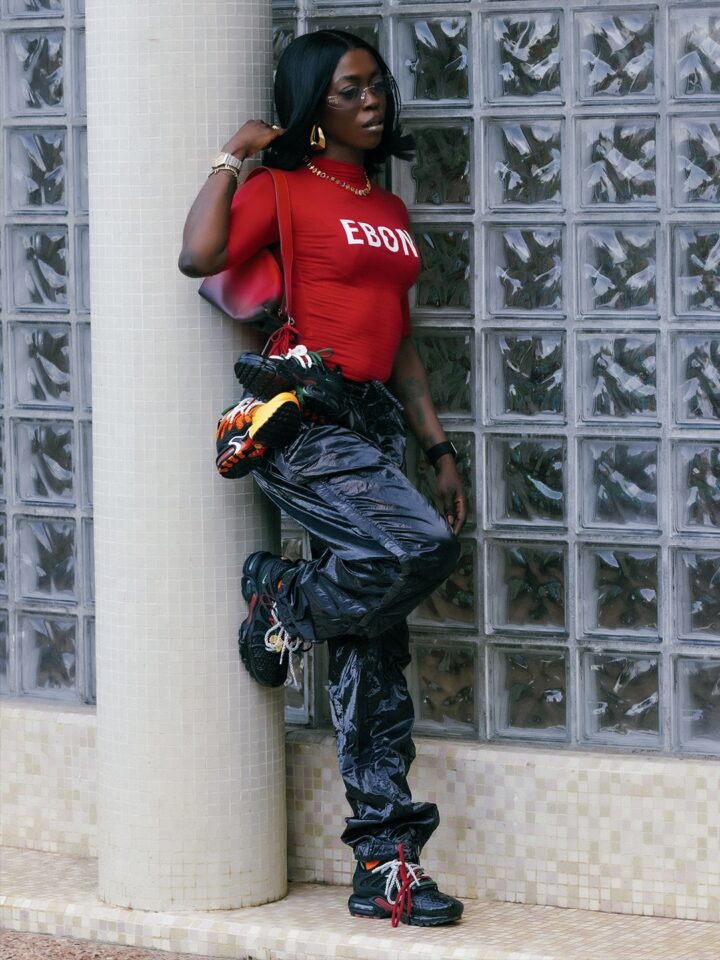
Now, she is not just wearing the culture—she is defining it.
Her dual British-Nigerian identity becomes central to the narrative. London informs the styling codes, Lagos informs the material language. The sneaker becomes a vessel for what it means to exist between places without fragmentation—a quiet rebuttal to the idea that diaspora identity must be divided.
In this way, the shoe is less about geography and more about multiplicity. It acknowledges that “home” is not singular—it is layered, shifting, and deeply personal.
Grace Ladoja’s Nike sneaker is not just a product launch. It is a manifesto—one that insists African stories deserve to be told by African voices, on global platforms, without dilution.
And in this moment, Ladoja is not just speaking—she is authoring a new chapter.